Johnny
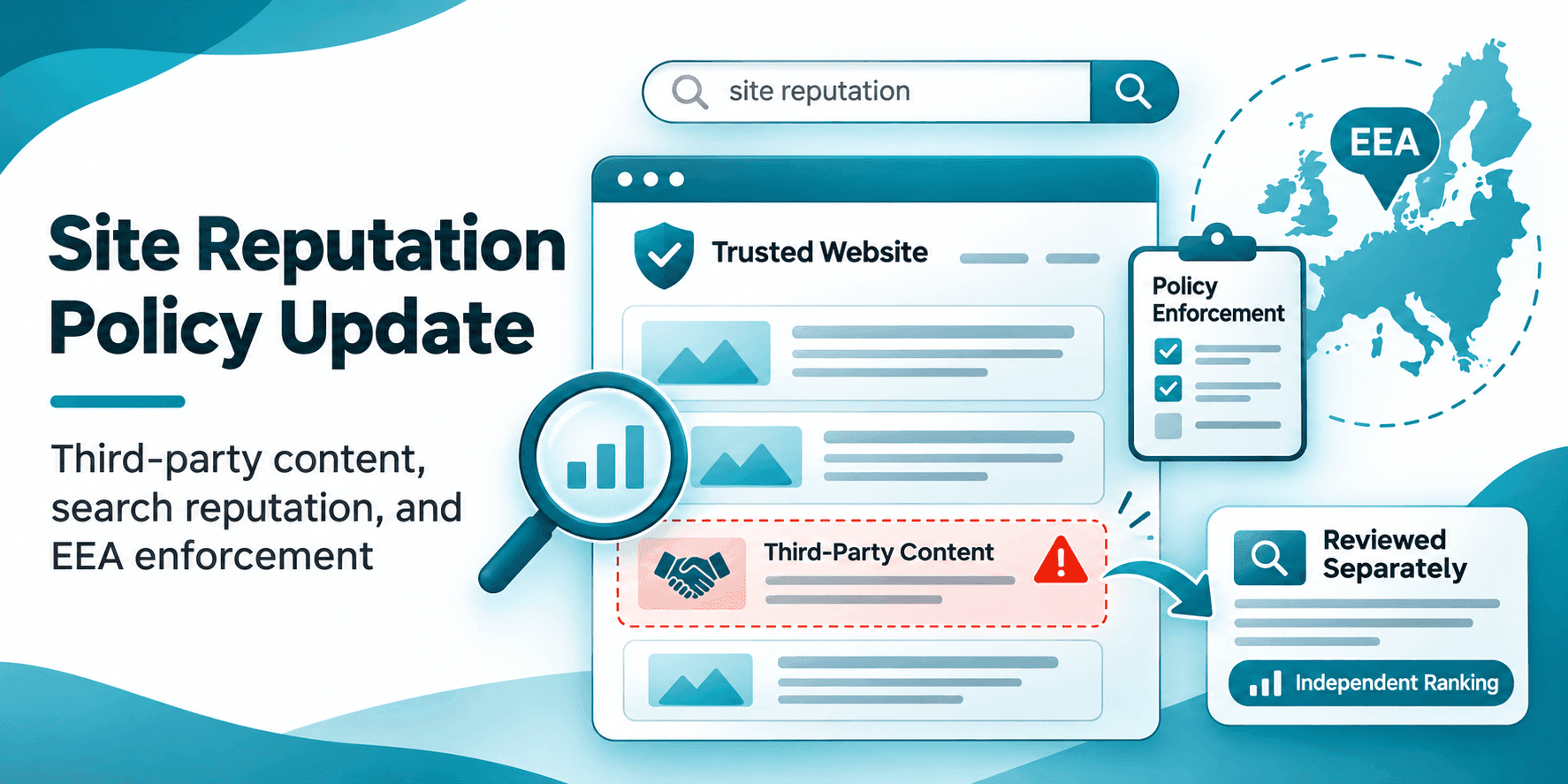
Google updated its site reputation policy to address third party content placed on trusted websites to take advantage of the host’s search reputation. The change affects how a manual action applies to searchers in the European Economic Area (EEA) compared with those elsewhere. If your site publishes contributed, syndicated, or partner content, review who controls it and why it appears on your domain. That gives you a clearer basis for deciding whether anything needs attention.
Google introduced the policy in 2024 to address a practice where third party content is published on an established site mainly to benefit from that site’s reputation in Search. The concern is not simply that content came from someone outside your company. The issue is whether the arrangement uses your domain’s standing to influence rankings in a way that does not serve searchers.
That distinction matters if you publish guest articles, partner material, or other externally produced content. Their presence alone does not establish that a policy violation occurred. Review the purpose, editorial oversight, and value of each arrangement instead of treating every third party page as a problem. Google’s policy update, published August 28, 2026, clarifies its enforcement approach.
Google says that, beginning August 30, 2026, a manual action under this policy has different effects depending on where the searcher is located. For searchers outside the EEA, the action directly affects search results for the portion of the site involved. Other parts of the site are not affected by that action.
For searchers in the EEA, the manual action’s impact does not apply. Google says the affected section may instead be separated in its systems over time and rank independently from the rest of the site. Because pages can be viewed around the world, the same page may have an action that affects results outside the EEA but not results shown to EEA users.
This is a difference in how the action affects search results, not a reason to assume the content is acceptable in one region. If a section is built around third party material, assess its editorial purpose and quality regardless of where your audience searches.
Start with an inventory of content created or supplied by people outside your organization. Depending on how your site is set up, your content management system may help you review authors, contributors, or publishing activity. A manual review is still useful: tools can show who published a page, but they cannot decide whether the page exists mainly to exploit your site’s reputation.
For each page or group of pages, ask:
Record what you find and prioritize arrangements that lack clear oversight or audience value. You may decide to improve, remove, or stop accepting particular material, but do not assume that deleting every externally produced page is necessary. Google’s announcement does not provide a universal audit procedure or say that all third party content violates the policy.
Google says site owners will continue to receive notifications in Search Console when a manual action is applied. Check for notices and read the details before making broad changes to your site. If you believe an action was applied in error, Google says you can submit a reconsideration request.
Eligible sites may also have the opportunity to bring disputes to mediation after submitting a reconsideration request. Mediation is not described as an option for every site, and a request does not guarantee that an action will be removed. Keep a record of the pages and publishing arrangements you reviewed, along with any changes you made, so you can explain your response clearly if you need to appeal.
Choose one area of your site that includes externally supplied content and review its authorship, editorial process, and purpose. Check for a manual action notice, document any concerns, and address specific weak arrangements rather than making sitewide changes based on guesswork. If you serve audiences in multiple regions, remember that the regional difference changes the effect of an action, not the need to maintain trustworthy, useful content.
It addresses third party content published on a trusted site mainly to take advantage of that site’s reputation to influence Search rankings.
Google says a manual action’s impact does not apply to search results shown to users in the EEA. The affected section may be separated in Google’s systems over time and rank independently.
No. The policy concerns third party content used mainly to exploit a host site’s reputation. Review the content’s purpose and editorial oversight rather than assuming outside authorship alone is a violation.
Google says site owners are notified in Search Console when a manual action is applied. If you believe it was applied in error, you can submit a reconsideration request. Mediation may be available to eligible sites.